

Biographie
I received my master’s degree equivalent (Diplôme d’Ingénieur), from Telecom Physique Strasbourg (TPS), Illkirch-Graffenstaden, France, in 2021. My general engineering studies focused on electronics and embedded systems. I deepened my knowledge in power electronics during my exchange program at the Karlsruhe Institute of Technology (KIT), Germany. Since late 2021, I have been pursuing a Ph.D. as part of the Real-Time Systems for Energy Technologies (RTSET) group and Energy Lab at KIT. In 2023, I spent a semester as a visiting researcher at the FREEDM Systems Center at North Carolina State University, USA.

Research in RTSET
My research focuses on real-time load parameter identification for the modeling and control of distribution networks. The goal is to develop a tool that can estimate load parameters in real-time, which is essential for understanding the load behavior and enabling rapid responses to support the electrical grid, such as through demand-side management. My work involves step-by-step analysis and proof of concept implementation in a Power-Hardware in The Loop environment, where actual loads are supplied by a power amplifier simulating the grid implemented in a real-time simulator.
Experience abroad
|
Time period: |
January – April 2024 |
|
Institution: |
FREEDM Systems Center, North Carolina State University, NC, USA
|
|
Location: |
Raleigh, NC, USA |


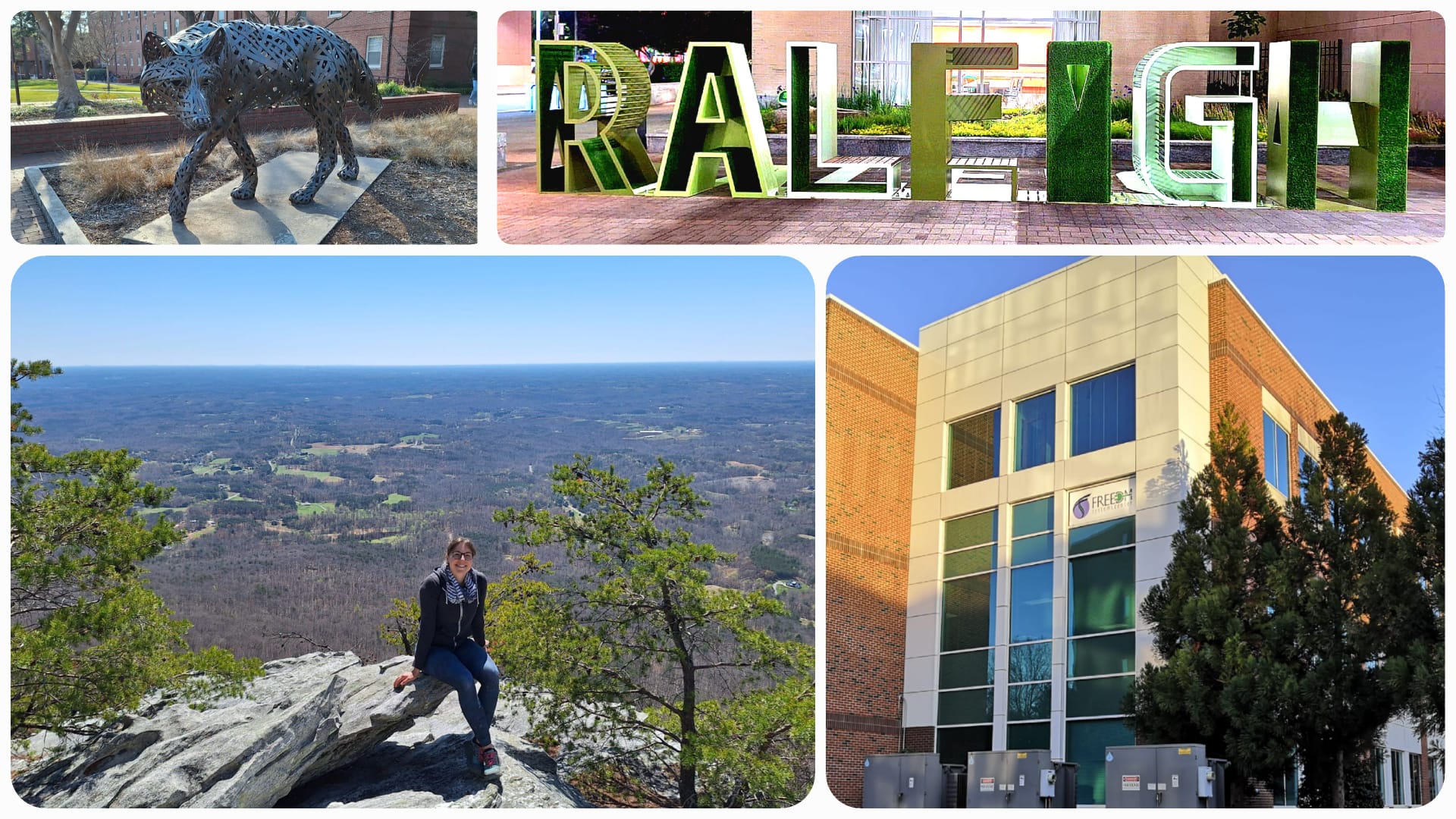
I had the chance to spend several months at NC State under the guidance of Dr. Ning Lu, initiating a collaboration between KIT and FREEDM Systems Center. During my time there, I was part of a new project examining how the complexity of load models influences the dynamic studies of power systems. We developed an initial benchmark model to be used in an AI-based decision-maker tool for selecting appropriate load models based on the specific study to be conducted. This project is part of the Center for Advanced Power Engineering Research (CAPER) initiative, where a collaboration of NC State with Clemson University and Duke Energy aims at enhancing modeling realism and industry applicability.
In addition to experiencing the working atmosphere and project-oriented research at a U.S. University, I benefited from high quality lectures and interactions with other students, which helped me better understand the differences between electrical grid systems in the US and Europe.
I was impressed by the spacious campus, facilities, and wide range of activities available to students. While NC State is a prestigious university in the engineering field, I found Raleigh to be smaller than I had imagined for a North American city. This allowed me to explore and enjoy the nature, lakes, forests and state parks of North Carolina, offering a refreshing perspective and perfect balance to the academic environment.
Technology Transfer
In 2025, I participated to the EXIST Women program, a German federal initiative supporting women researchers in exploring entrepreneurship. Through this experience, I gained insights into how research can create an impact in the industrial world, all within a respectful and supportive environment.
Communication in Science
Science should not be limited to discussions among expert. Everyone can be interested in understanding how electricity is generated or how challenging it is to ensure reliable power distribution in systems with increasing shares of renewable energy. In April 2025, I participated in FameLab Southwest Germany, where I presented my PhD topic in exactly 3 minutes, demonstrating that electrical loads (the public) can actively contribute to balancing the grid (the music).
Covered by clicKIT magazine
Youtube video available: famelabgermany
Publication list
Tao, Q.; Courcelle, M.; Wald, F.; Yun, J.; Geis-Schroer, J.; Suriyah, M.; Leibfried, T.; De Carne, G.
2026. IET Generation, Transmission & Distribution, 20 (1). doi:10.1049/gtd2.70348
Courcelle, M.; Ekin, Ö.; Carne, G. De; Hagenmeyer, V.
2025. 2025 10th IEEE Workshop on the Electronic Grid (eGRID), 1–6, Institute of Electrical and Electronics Engineers (IEEE). doi:10.1109/eGRID63452.2025.11255307
Tao, Q.; Courcelle, M.; Wald, F.; Carne, G. de
2025, July 24. Energy Symposium: Powering the Future - Accelerating the Energy Transition (2025), Karlsruhe, Germany, July 24–27, 2025
Tao, Q.; Courcelle, M.; Geis-Schroer, J.; Leibfried, T.; Carne, G. D.
2024. IEEE Transactions on Power Delivery, 39 (6), 3243–3254. doi:10.1109/TPWRD.2024.3457578
Courcelle, M.; Tao, Q.; Geis-Schroer, J.; Leibfried, T.; Carne, G. De
2024. IEEE Transactions on Power Delivery, 39 (6), 3114–3125. doi:10.1109/TPWRD.2024.3453270
Geis-Schroer, J.; Tao, Q.; Courcelle, M.; Bock, G.; Suriyah, M.; Leibfried, T.; Carne, G. De
2024. IEEE Transactions on Industry Applications, 60 (6), 9184–9194. doi:10.1109/TIA.2024.3439498
Tao, Q.; Courcelle, M.; Carne, G. De
2024, July 23. IEEE Power and Energy Society General Meeting Student Poster Session (IEEE PES GM 2024), Seattle, WA, USA, July 21–25, 2024
Courcelle, M.; Tao, Q.; Carne, G. De
2024. 2024 IEEE Power & Energy Society General Meeting (PESGM), 1–5, Institute of Electrical and Electronics Engineers (IEEE). doi:10.1109/PESGM51994.2024.10688776
Courcelle, M.; Tao, Q.; Geis-Schroer, J.; Bruno, S.; Leibfried, T.; Carne, G.
2023. 2023 IEEE Belgrade PowerTech, Belgrade, Serbia, 25-29 June 2023, Institute of Electrical and Electronics Engineers (IEEE). doi:10.1109/PowerTech55446.2023.10202677
Tao, Q.; Geis-Schroer, J.; Courcelle, M.; Leibfried, T.; Carne, G. De
2023. 2023 11th International Conference on Power Electronics and ECCE Asia (ICPE 2023 - ECCE Asia), 329–334, Institute of Electrical and Electronics Engineers (IEEE). doi:10.23919/ICPE2023-ECCEAsia54778.2023.10213527
Courcelle, M.; Kottonau, D.; Carne, G.
2022. 2022 IEEE Energy Conversion Congress and Exposition (ECCE), 1–7, Institute of Electrical and Electronics Engineers (IEEE). doi:10.1109/ECCE50734.2022.9948022
Tao, Q.; Geis-Schroer, J.; Wald, F.; Courcelle, M.; Langwasser, M.; Leibfried, T.; Liserre, M.; Carne, G.
2022. 2022 IEEE 13th International Symposium on Power Electronics for Distributed Generation Systems (PEDG), 1–6, Institute of Electrical and Electronics Engineers (IEEE). doi:10.1109/PEDG54999.2022.9923112